


Saturday, February 26, 2011

Long Bread Lines and Barricades in Libya’s Capital
| Long Bread Lines and Barricades in Libya’s Capital - NYTimes.com | |

Moises Saman for The New York Times
The funeral for Anwar Elgadi, 44, in Tripoli on Saturday. He was shot in the head on Friday during clashes with security forces. More Photos »
By DAVID D. KIRKPATRICK
Published: February 26, 2011
TRIPOLI, Libya — A bold play by Col. Muammar el-Qaddafi to prove that he was firmly in control of Libya appeared to backfire Saturday, as foreign journalists he invited to the capital discovered blocks of the city in open defiance of his authority.
Multimedia


Libya After Qaddafi
What can the world do to keep a brutalized country from falling apart?

Lynsey Addario for The New York Times
Libyans rallied against Col. Muammar el-Qaddafi in Benghazi on Saturday. Rebels have taken over and hold much of the east. More Photos »
Witnesses described snipers and antiaircraft guns firing at unarmed civilians. Many said security forces had been removing the dead and wounded from streets and hospitals, apparently in an effort to hide the mounting toll.
But when government-picked drivers escorted journalists on tours of the city on Saturday morning, the extent of the unrest was unmistakable. Workers were still hastily painting over graffiti calling Colonel Qaddafi a “bloodsucker” and demanding his ouster.
Just off the tour route were long bread lines where residents said they were afraid to be seen talking to journalists.
And though government forces dominated the city center — heavily armed checkpoints staked out downtown while orange-suited cleanup crews were out in force around the central Green Square — there were signs of defiance in other neighborhoods, where the streets were blocked by makeshift barricades of broken televisions, charred tree trunks and cinder blocks left over from protests and street fights the night before.
“I have seen more than 68, I think, people killed,” said a doctor who had been helping out at a neighborhood clinic in Tajoura and gave his name only as Hussein. “But the people who have died, they don’t leave them in the same place.
We have seen them taking them in the Qaddafi cars, and nobody knows where they are taking the people who have died.” He added, “Even the ones with just a broken hand or something they are taking away.”
In some ways, the mixed results of Colonel Qaddafi’s theatrical gamble — opening the curtains to the world with great fanfare, even though the stage is in near-chaotic disarray — are an apt metaphor for the increasingly untenable situation in the country.
There were unconfirmed reports Saturday that thousands of armed rebels from other regions of the country were marching toward Tripoli. Rebels have already taken over and held the eastern half of the populous coast. On Saturday, after days of fighting, they also reportedly took Sabratha, a town near the capital known for its Roman ruins.
At the birthplace of the revolt, in the eastern city of Benghazi, a group of senior military officers who had defected were forming a council to lead their troops against Colonel Qaddafi’s forces. One of them, an air force general, said three air bases had defected to the rebels, along with the region’s military police.
And the rebels said they were in the process of forming an interim government to oversee the areas no longer under Colonel Qaddafi’s control. It is expected to include Mustafa Mohamed Abd al-Jalil, a former justice minister who quit to join the insurrection and may now assume the role of interim prime minister.
“The temporary location of the government will be Benghazi, until the liberation of Tripoli,” said Iman Bugaighis, a spokeswoman for a coalition of antigovernment activists.
But so far, the protesters say, the rebel force heading for Tripoli has been stymied at Surt, a Qaddafi stronghold on the coastal road where his tribe is concentrated. In Tripoli, home to nearly two million of Libya’s roughly six and a half million people, Colonel Qaddafi and his special militias may have unleashed enough firepower to enable them to keep a firm grasp on the city for some time.
His plainclothes police and uniformed security forces appeared in control of most of the city’s largely deserted streets on Saturday, and there were unconfirmed reports that he was following through on his threats to distribute weapons to his supporters.
Clearly, both the rebels and Colonel Qaddafi appear to have the will and the wherewithal to fight on for some time.
Source: www.nytimes.com
Anti-government protests: Allah is preparing the Ummah for victory
SATURDAY, 26 FEBRUARY 2011 14:49 ABDUL-KAREEM


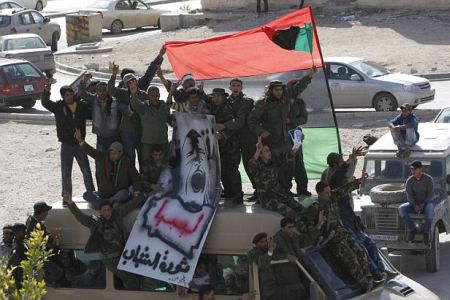
As anti-government protests sweep the Muslim world and tyrants begin to fall the question of who will replace them is now on the minds of the ummah.
If we look back to the time of the Prophet صلى الله عليه وسلم and his struggle to establish the first Islamic State, we see he صلى الله عليه وسلم approached many tribes seeking the support (nussrah) for establishing the authority of Islam. He صلى الله عليه وسلم suffered persecution and difficulty in seeking the nussrah most notably in Ta'if where they hurled insults and stones at him until the whole of his body including his feet bled.
Whilst the Prophet صلى الله عليه وسلم and sahaba were struggling in the dawah in Makkah, Allah سبحانه وتعالى was preparing two tribes with the honour of becoming the future Ansar who supported the establishment of the first Islamic State in Medina.
These two tribes were Al-Aws and Al-Khazraj and five years before the hijra a severe battle took place between them called the Battle of Bu'ath, which led them on the path to becoming Muslim and giving the final nussrah.
'Aisha (ra) narrates about this point: The day of Bu'ath was a day (i.e. battle) which Allah caused to take place just before the mission of His Messenger so that when Allah's Messenger came to Medina, they (the tribes) had divided (into hostile groups) and their nobles had been killed; and all of that facilitated their conversion to Islam. [Bukhari]
The Battle of Bu'ath was a defining moment in the history of Islam and the anti-government demonstrations today may also turn out to be such a turning point.
Today, the ummah is feeling the shocks of the regimes collapsing and martyrs falling in the streets and this will generate an intellectual process which seeks answers for a way forward.
This is mentioned by Taquideen an-Nabhani in the book Attakattul el-Hizbi (Structuring of a Party):
Vitality usually streams into the Ummah when severe shocks occur in the society and produce a common feeling. This collective feeling leads to an intellectual process, which in turn produces a host of propositions and ideas as a result of discussions about the causes and effects of the shock, as well as the direct and indirect means to save the Ummah.
The problems people face in life will naturally provoke thinking in the person as they search for a solution. Similarly, the severe problems and shocks faced by the ummah during the fall of the tyrants have provoked many elements of the society to question and debate the next steps. The scholars, politicians, media, political parties, army, Islamic groups and western governments are all involved in this debate to varying degrees of influence. Even if after the revolutions in Tunisia, Egypt, Libya and beyond a Khilafah does not emerge, this should not be a source of despair for the ummah and the dawah carriers in particular. Rather these demonstrations have achieved many positive outcomes for the Islamic revival and are a step closer to the victory of Allah سبحانه وتعالى and the establishment of the Khilafah.
1. For any idea to become a concept that shapes people's behaviour it must have a reality that people can perceive and relate to. During the 1950's and 60's in the Arab world there was widespread support for the rulers even though they were dictators ruling by non-Islam who upheld the interests of their colonial masters. At this time Hizb ut-Tahrir exposed the rulers, their oppression and their subservience to the west but this was viewed as "strange" by many in the ummah. However, actions speak louder than words, and over time through decades of oppression the ummah has realised who their rulers truly are. The hatred of the tyrants, the destruction of their portraits and hounding them out the country shows the ummahs true feelings towards them.
2. The ummah were in fear of the rulers who tortured, abused and imprisoned them. Those few dawah carriers who stood up were dealt with brutally to the point where thousands languished in the dungeons of the tyrants. But these demonstrations removed the fear from the ummah who faced the tanks and live ammunition with their bare chests chanting Allahu Akbar!
3. The hypocrisy of western leaders who supported and armed these tyrants is now plain for the ummah to see, such as when the police use anti-riot weapons with "made in Britain" on them or when the British PM tours the Middle East with arms companies in tow.
4. The Hizb adopted a clear and precise method for establishing the Islamic State from the sunnah of the Prophet صلى الله عليه وسلم, which stressed the importance of building a public opinion for revival and gaining the physical support (nussrah) from those who prop up the rulers (primarily the armies). Many Islamic groups rejected this method in favour of compromise, gradualism and power sharing with the governments. Yet the millions protesting in Tunis and Cairo proved beyond a shadow of a doubt the power of public opinion in generating change.
5. Some Islamic movements condemned the Muslim armies as corrupt and began developing their own nussrah by creating armed groups to fight the governments directly, or ignored the armies completely in their dawah believing public opinion was enough. However, the pivotal role the armies played in propping up the regimes became clear when the armies removed their support for Ben Ali and then Mubarak. The army in Tunisia, Egypt and now Libya refused to fire on demonstrators and many held their own demonstrations and joined the protestors. The days spent mingling with the armies has helped break down the barriers imposed by the tyrants and will lead to greater dialogue and trust in the future between the armies and the wider society.
6. Another positive outcome is an awakening of the scholars who may now begin to distance themselves from the corrupt regimes and take their place as leading figures in the Islamic revival.
A statement issued by 90 preachers and religious scholars from all over the Muslim world praised the revolutions that ousted the dictatorships of Tunisia and Egypt for defeating oppression and ushering in a new era of justice and freedom.
The statement, however, criticized the revolution's call for the installation of full democracies. Democracy, Muslim clerics argued, allows the people have the final say in their countries' affairs, which leads to the prevalence of several un-Islamic practices.
"In democracies, people might vote for things that are prohibited in Islam like establishing brothels, allowing homosexuality, drinking alcohol, and usury, and prohibiting the call for prayers or the veil."
Calling itself the Network of Free Ulema of Libya, the group of over 50 Muslim scholars said the government and its supporters "have demonstrated total arrogant impunity and continued, and even intensified, their bloody crimes against humanity."
"They have thereby demonstrated total infidelity to the guidance of God and his beloved Prophet صلى الله عليه وسلم," said the undated statement obtained by Reuters on Monday.
"This renders them undeserving of any obedience or support, and makes rebelling against them by all means possible a divinely ordained duty," said the scholars, who asked not to be named for security reasons.
7. In Tunisia Islam was suppressed for decades. The post "independence" leader Bourguiba called the hijab an "odious rag", seized properties held by Islamic trusts, closed their courts and enshrined secular family codes. He even went so far as arguing that fasting during Ramadan should not be observed for it reduces productivity! He then appeared on television with his cabinet, eating and drinking during Ramadan! His successor Ben Ali was no different. Women who wore hijab were denied access to education and jobs. Many say police used to stop them in the streets, strip them of their headscarves and force them to sign papers renouncing the hijab. Men with long beards were similarly treated.
A similar suppression occurred in Central Asia under the Soviets where they closed down mosques and drove Islam underground. However, after the collapse of the Soviet Union Central Asia saw Muslims re-opening their mosques, women wearing hijab and people starting to learn their religion. Central Asia today has millions of supporters for Khilafah. Tunisia may go in a similar direction. The mosques are beginning to fill up, women openly wearing hijab and public protests calling for Islam.
The Muslims living in the future Khilafah may very well study these protests in their history books and see the part they played in reviving the ummah and establishing the Khilafah, just as the Battle of Bu'ath did in establishing the first Islamic State.
Allah سبحانه وتعالى tests the Muslim ummah out of love so they become purified and return to the straight path - sirat ul-mustaqim. These tests bring us closer to the victory of establishing the Khilafah and prepare the ummah for being the future rulers of the world.
The Prophet صلى الله عليه وسلم said: "A man will continue to be tested until he walks upon the face of the earth with no sin on him." [Ahmed]
The dawah carriers now face a test to answer the ummah's questions that have arisen as a result of these shocks and explain the correct Islamic concepts and Islamic method for moving the Muslim world forward. Even if these protests bring no immediate change we shouldn't be disheartened or become defeated that we can never establish the Khilafah. Rather it means we need to work harder to gain Allah's سبحانه وتعالى pleasure and work righteous deeds so we are worthy of victory.
وَعَدَ اللَّهُ الَّذِينَ آمَنُوا مِنْكُمْ وَعَمِلُوا الصَّالِحَاتِ لَيَسْتَخْلِفَنَّهُمْ فِي الْأَرْضِ كَمَا اسْتَخْلَفَ الَّذِينَ مِنْ قَبْلِهِمْ وَلَيُمَكِّنَنَّ لَهُمْ دِينَهُمُ الَّذِي ارْتَضَىٰ لَهُمْ وَلَيُبَدِّلَنَّهُمْ مِنْ بَعْدِ خَوْفِهِمْ أَمْنًا ۚ يَعْبُدُونَنِي لَا يُشْرِكُونَ بِي شَيْئًا ۚ وَمَنْ كَفَرَ بَعْدَ ذَٰلِكَ فَأُولَٰئِكَ هُمُ الْفَاسِقُونَ
"Allah has promised those of you who have iman and do right actions that He will make them successors in the land as He made those before them successors, and will firmly establish for them their deen with which He is pleased and give them, in place of their fear, security. ‘They worship Me, not associating anything with Me.' Any who are kafir after that, such people are deviators." [An-Nur, 24:55]
Source:www.khilafah.com/
Revolutions: False comparisons and the agent of change
SATURDAY, 26 FEBRUARY 2011 15:08 ABID MUSTAFA
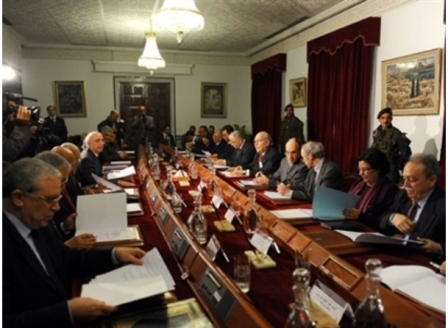
The unprecedented torrents of revolt sweeping in the Arab world have led many observers to make comparisons with the demise of the Iron Curtain in 1989 or the Iranian revolution in 1979. Both assessments in many ways are misleading-at best they are simply fictitious.
In the fall of the Iron Curtain nations abandoned ‘godless socialism' and embraced free market capitalism. Eastern European countries shifted from Russia's sphere of influence to American colonization. The super power struggle between Soviets and the Americans ended with Russia's defeat and the ascendency of the lone super power America.
In contrast, the domino effect that is toppling autocratic leaders across the North Africa has not ended free market capitalism, nor has it ousted the world's lone super power. Tunisia and Egypt remain staunchly secular, its solutions are capitalistic in nature and both are firmly in the grip of Britain and America. Furthermore, the geopolitical struggle is confined between Europe and America over who controls the hydrocarbons and other riches of the Arab world. If change does materialize, then this will merely be the elimination of European hegemony-especially British control- over countries like Morocco, Algeria, Tunisia, Libya, Yemen and the Gulf countries. Additionally, the face of the ruling system and apparatus will undergo some modifications to make America's rule more palatable to the people and stymie further uprisings.
Equating the Arab revolution with the Iranian one is equally flawed. The fall of the Shah and the arrival of Khomeini only switched the rule in Iran from British hands to America hands. Capitalism still flourishes and is peppered with Islamic dressing which to most observers is misconstrued as a form of theocracy. The fact of the matter is that Iran is a secular regime with some facets of democracy and staunchly operates within ambit of American rules. Again, the present uprising in Iran is not seeking an end to capitalism, American hegemony or for that matter an end to Western patronage. This is the only similarity between the present rebellions in the Arab world and the Iranian revolution.
If valuable lessons have to be learnt then it is quite evident that almost all revolutions in societies that covet change -irrespective of ideological orientations-require domestic partners that can tangibly deliver change and ensure genuine independence from Western interference. These partners are the powerful armies of the Arab and Muslim countries. General Rachid Ammar of Tunisia and General Chief of Staff Lieutenant General Sami Hafiz could have easily catapulted the revolutions towards real and meaningful change. Instead, they betrayed the pure feelings of their people and chose to stand by their Western masters Britain and America. Therefore in both cases the regimes that were responsible for years of despotism, aggression and kufr are still in place awaiting further instructions from the West.
Allah says in Surah Ar-Ra'ad:
إِنَّ اللَّهَ لَا يُغَيِّرُ مَا بِقَوْمٍ حَتَّىٰ يُغَيِّرُوا مَا بِأَنْفُسِهِمْ
"Verily, Allah does not change the condition of a people until they change what is within themselves."
The ummah must realize that their appalling situation is destined to change but they must put pressure on the armies who are part of the ummah to join them in this quest to liberate the ummah from the yoke of Western colonialism an return to the rule of Islam.
Feb 22 2011
Source:www.khilafah.com/
Qaddafi Forces Shooting From Ambulances, Witnesses Say
SATURDAY, 26 FEBRUARY 2011 15:23
By DAVID D. KIRKPATRICK and SHARON OTTERMAN
TRIPOLI, Libya - An increasingly gruesome picture began to emerge Saturday of the violent tactics used by the government of Col. Muammar el-Qaddafi to quell protesters in Tripoli, the Libyan capital, with several witnesses confirming that forces loyal to the government had been shooting people from ambulances and using antiaircraft guns against crowds.
Witnesses to the violence in Tripoli, where a tense standoff held on Saturday, also said that the government had removed dead bodies as well as the wounded from hospitals in an effort to disguise the mounting death toll in the uprising against Col. Qaddafi sweeping Libya.
Col. Qaddafi's forces had put down demonstrators, who had taken to the streets after Friday Prayers to mount their first major challenge to the government's crackdown, with snipers from rooftops, buckshot, and tear gas, witnesses said. There were unconfirmed reports that an armed rebel force was approaching the city on Saturday.
In Tajoura, a neighborhood of the capital where there has been significant fighting since a peaceful demonstration there last Sunday, residents had barricaded a street with old television sets and cinderblocks to try to keep out pickup trucks full of men with machine guns. A doctor working at the local clinic here said he had seen 68 people killed and 150 injured in recent days of clashes, and that residents were braced for more violence.
A rebel officer who is coordinating an attack on Tripoli, Col. Tarek Saad Hussein, asserted in an interview that an armed volunteer force of about 2,000 men - including army defectors - was to arrive in Tripoli on Friday night. There was no way to confirm his claim.
Protesters in Tripoli said that they had heard a force was on its way from the eastern cities that had fallen to rebels, but that they had been stopped in Surt, a remaining Qaddafi stronghold halfway between Tripoli and Benghazi, the opposition-controlled city where the uprising began.
Colonel Hussein was especially angered at the reports of security forces' firing on protesters after prayers. "They did not have weapons," he said, speaking at an abandoned army base in the eastern city of Benghazi, which is firmly under rebel control. "They shot people outside the mosque."
Indeed, accounts of the bloodshed on Friday indicated that Colonel Qaddafi's forces had deployed the same determined brutality as they had earlier in the week defending their leader, who has ruled for more than 40 years.
"They shoot people from the ambulances," said one terrified resident, Omar, by telephone as he recalled an episode during the protests on Friday when one protester was wounded. "We thought they'd take him to the hospital," he said, but the militiamen "shot him dead and left with a squeal."
A precise death toll might be impossible. Omar said that friends who were doctors at a hospital in Tripoli saw bodies being removed from the morgue to conceal the death toll. Local residents told him that the bodies were being taken to beaches and burned. Omar did not want his full named used for fear of his life.
"We have no freedom here," he said. "We want our freedom, too."
Heba Morayef, a researcher with Human Rights Watch trying to confirm the number of fatalities, said she had heard widespread reports of security forces inside hospitals. Top officials of the biggest Tripoli hospitals were said to be loyal to Colonel Qaddafi and understating the casualties, she said.
The deputy ambassador to the United Nations, Ibrahim Dabbashi, had also said in New York on Friday that government forces had been shooting from ambulances, as he pleaded for international action to help stop the violence.
"Hundreds of people have been killed. We expect thousands to be killed" in Tripoli, he told reporters.
The Tripoli airport has become a refugee camp packed with thousands of people trying to flee. The floors inside are a carpet of flesh and blankets, including families with children. Outside, a thick wall of thousands of refugees was waiting to get in, and at least two guards were beating them back - one with a billy club and the other a whip.
The city had been cleansed Thursday night for a visit by a number of foreign journalists the Qaddafi government has invited. Billboards with pictures of Colonel Qaddafi that were burned and defaced last week have all been restored, witnesses said. "It is a stage set they built overnight," one resident said.
Witnesses in Tripoli said that the streets were lined with extra police officers in riot gear before Friday Prayer services, and militia members patrolled the area near Bab al-Aziziya, Colonel Qaddafi's military base.
A resident who spoke with friends in several neighborhoods said the police opened fire on worshipers after the prayers, killing at least five people in Siyahiya, in western Tripoli, and several other people in Zawiat al-Dahmani, in the city's center.
There were also reports of gunfire in Fashloom and the Souq al-Jumaa area. Those reports could not be immediately confirmed.
It was no longer possible to reach Tripoli's central Green Square, the scene of many of the demonstrations - and much of the slaughter. The area was surrounded by checkpoints and barricades patrolled by members of the armed forces, Omar and other witnesses said.
Indeed, earlier Friday, Libyan state television showed Colonel Qaddafi speaking from a parapet overlooking Green Square and addressing a crowd of supporters. There was no sign of resistance, only the sight of thousands of young loyalists. There was no way to know if the broadcast was live or pre-recorded.
"This is the formidable, invincible force of youth," Colonel Qaddafi said. "Life without dignity is useless." He blew kisses to the crowd and urged them to fight to the death. "Every individual will be armed," he said. "Libya will become a hell."
Libyan state television also announced that the government would give $400 to every family and raise the salaries of state employees by as much as 150 percent, in what appeared to be an attempt to buy support.
But the gesture was too late to stop more painful defections. Libya's ambassador to the United Nations, Abdurrahman Shalgham, a longtime friend of Colonel Qaddafi, denounced him Friday in New York, comparing him with Pol Pot and Hitler.
Libya's entire Arab League mission resigned for the same reasons on Friday, as did the country's mission in Geneva.
Ahmed Gadhaf al-Dam, one of Colonel Gaddafi's top security official and a cousin, left Wednesday evening, it was revealed, for Egypt, where he denounced Colonel Qaddafi's "grave violations to human rights."
The protesters in Tripoli appeared emboldened by promises of help from rebels outside the capital and the surprisingly strong showing of protesters in cities close to the capital on Thursday against Colonel Qaddafi's forces, which brought the rebellion to the capital's doorstep.
A potentially large force of armed fighters sympathetic to the protesters was now converging on Tripoli, according to military officials and soldiers who had defected to the rebels.
Colonel Hussein said the force consisted of active duty, retired soldiers and army reservists who had joined the rebel side. It was sent to the capital in small groups, he said, adding that they carried a mixture of light arms and heavier weapons, including rocket-propelled grenades.
He did not offer more details about the size of the groups, or their route. The road to Tripoli from the country's eastern cities is blocked to the rebels by the city of Surt, Colonel Qaddafi's hometown.
Colonel Hussein said he was negotiating with tribal leaders and military officers in Surt to abandon the government, or at least not stand in the way of the rebels. "We're appealing to the people of Surt to help us stop the bloodshed," he said.
Army soldiers stationed at a barracks near Benghazi said on Friday that 200 to 250 of their colleagues had left the barracks in recent days, headed to Tripoli to fight Colonel Qaddafi's forces.
A group of 60 or so officers stood outside another barracks in Benghazi on Friday, saying they were volunteering to go fight in Tripoli. Colonel Hussein said they were joining the battle because protesters were being killed. "In cold blood," said Colonel Hussein.
Asked what would happen if Colonel Qaddafi was deposed or killed, Colonel Hussein said Libyans wanted a democracy.
"It was our duty to enter the fight," he added. "The regime started this. They are the ones who brought the revolution."
David D. Kirkpatrick reported from Tripoli, and Sharon Otterman from Cairo. Kareem Fahim contributed reporting from Benghazi, Libya.
VIDEO: Libyan revolution - causes and its uniqueness to others - Osman Bakhach (HT Media Office; Press TV)
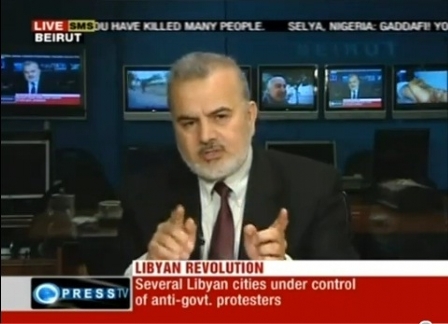
What is unique about the Libyan revolution compared to Egypt, Tunisia, etc? Why is it important that there is a lack of alternative figurehead to fill the power hole? Is this why the Americans and other western regimes have acted slower compared to Egypt? There are clear differences between Egypt (and others) and Libya which may be reasons for the massacre. An important interview on the causes of the Libyan revolution: the geopolitics, and why Gaddafi will go and why it indicates a historic moment. Press TV. With Osman Backach, director of the Global Media office of Hizb ut Tahrir.
Gaddafi, the enemy of Allah, His Messenger and the Ummah kills hundreds or even thousands of people
FRIDAY, 25 FEBRUARY 2011 10:31 OSMAN BAKHASH
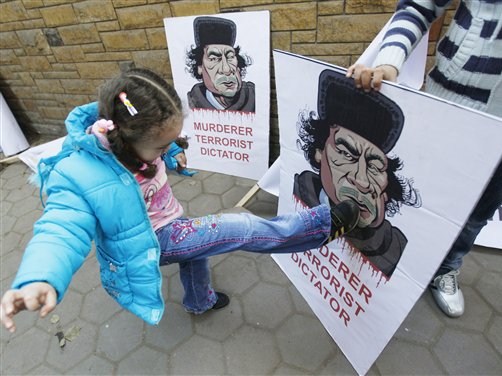
Gaddafi, the enemy of Allah, His Messenger and the Ummah kills hundreds or even thousands of people, bombarding them by plane and lethal weapons; and his son threatens to slaughter the people of Libya and fight against them until the last man.
With complete arrogance, conceit and criminality Gaddafi's son - Saif ash-Shaytan - says they will continue to slaughter the people of Libya to the last man!! Gaddafi and his son brought hired murderous mercenaries to slaughter and shed the clean and innocent blood!! We are not surprised because Gaddafi, the enemy of Allah who has denied the Sunnah of the Prophet صلى الله عليه وسلم and tried to distort the Qur'an. His history is full of heinous massacres of hundreds, even thousands of people in Libya and beyond!With regards to the Islamic movements, including Hizb ut-Tahrir, and even all the people of Libya, Gaddafi has not observed any respect of either ties of kinship or of covenant! We will never forget the execution of thirteen members of Hizb ut-Tahrir, where he executed them inside the schools and universities in front of the teachers and students, and in front of their families and children.
We pray to Allah, The Mighty, The Irresistible, The Avenger, The Supreme to make the blood of those killed at the hands of Gaddafi the blood of martyrdom, and to make these people in the company of the Prophets, the sincere, the martyrs and the righteous. Oh! What a beautiful companionship. May Allah take revenge on this tyrant, and take him with such penalty as comes from one Exalted in power.
إِنَّ أَخْذَهُ أَلِيمٌ شَدِيدٌ
"Indeed His punishment is painful, severe." [Hud, 11:102]
O heroes in Libya!
Indeed you have written a bright history with your patience, strength and bravery before the oppression and terror of the enemy of Allah. We ask Allah to give you perseverance and strength so as to uproot this criminal puppet, and confine him, his son and his entourage to the dustbin of history with the other traitors. The ummah will stone their graves as they stoned the grave of Abu Rughaal.*
And I stone his grave every year
As the people stone the grave of Abu Rughaal
O sincere sons of Libya's army!
How long will you continue silent and motionless without making a move that Allah and His Messenger love!! Is it not time that your hearts submit to the command of Allah? Do you not love to make a shining history for yourselves as the supporters (ansaar) of the Messenger of Allah صلى الله عليه وسلم did!? We call upon you to overthrow the Gaddafi regime, and support the people of Libya, and to work with Hizb ut-Tahrir, which you know and whose members you know well - so as to declare Libya as a Khilafah on the model of prophethood, which will bring Islam back to this world, with its doctrine and system. Thus, you bring to yourselves glory in this world, but what you will have with Allah is greater.
إِنَّ الَّذِينَ يُحَادُّونَ اللَّهَ وَرَسُولَهُ أُولَٰئِكَ فِي الْأَذَلِّينَ
"Indeed, those who resist Allah and His Messenger will be among the most humiliated." [Al-Mujaadila, 58:20]
Osman Bakhash
Director, Central Media Office
Hizb ut-Tahrir
18 Rabi al-Awal 1432H
21 February 2011
* Ibn Ishaq said: Al-Lat was a 'sacred' House in Ta'if, it was to them just as the Ka' bah was to the rest of the Arabs. They sent a man called Abu Rughal to show him (Abraha, leader of the people of the Elephant) the way to Mecca. They went on till they arrived at a place called Al-Maghmas where Abu Rughal died. Abu Rughal was buried there and afterwards, and the Arabs used to stone his grave.
Subscribe to:
Posts (Atom)


10 Jan 2010
Ketika berbicara di televisi BBC, Perdana Menteri Inggris Gordon Brown menyerukan intervensi lebih besar dari Barat di Yaman dan menyerang tuntutan bagi kekhalifahan dunia di dunia Muslim sebagai sebuah “ideologi pembunuh” dan suatu “penyimpangan dari islam “.
Taji Mustafa, Perwakilan Media Hizbut Tahrir Inggris berkata: “Gordon Brown, seperti halnya Tony Blair yang memerintah sebelumnya, berbohong [...]


09 Jan 2010
بِسْـــمِ اللهِ الرَّحْمٰـــنِ الرَّحِيـــم
Sia-sia Saja Menggantungkan Harapan Kepada Rencana-rencana Pemerintahan Partai Keadilan dan Pembangunan (AKP)!
Pemerintahan Partai Keadilan dan Pembangunan...
Index Leaflet


 Loading ...



ACFTA-PASAR BEBAS 2010: “BUNUH DIRI EKONOMI INDONESIA”
Mulai 1 Januari 2010, Indonesia harus membuka pasar dalam negeri secara luas kepada negara-negara ASEAN dan Cina. Sebaliknya, Indonesia dipandang akan mendapatkan kesempatan lebih luas untuk memasuki pasar dalam negeri negara-negara tersebut. Pembukaan pasar ini merupakan perwujudan dari perjanjian perdagangan bebas antara enam negara anggota ASEAN (Indonesia, Thailand, Malaysia, Singapura, Filipina dan Brunei Darussalam) dengan Cina, [...]


Download buku-buku yang dikeluarkan Hizbut Tahrir, dalam bahasa Indonesia, Arab dan Inggris.


